AIDS Energy
Episode 9

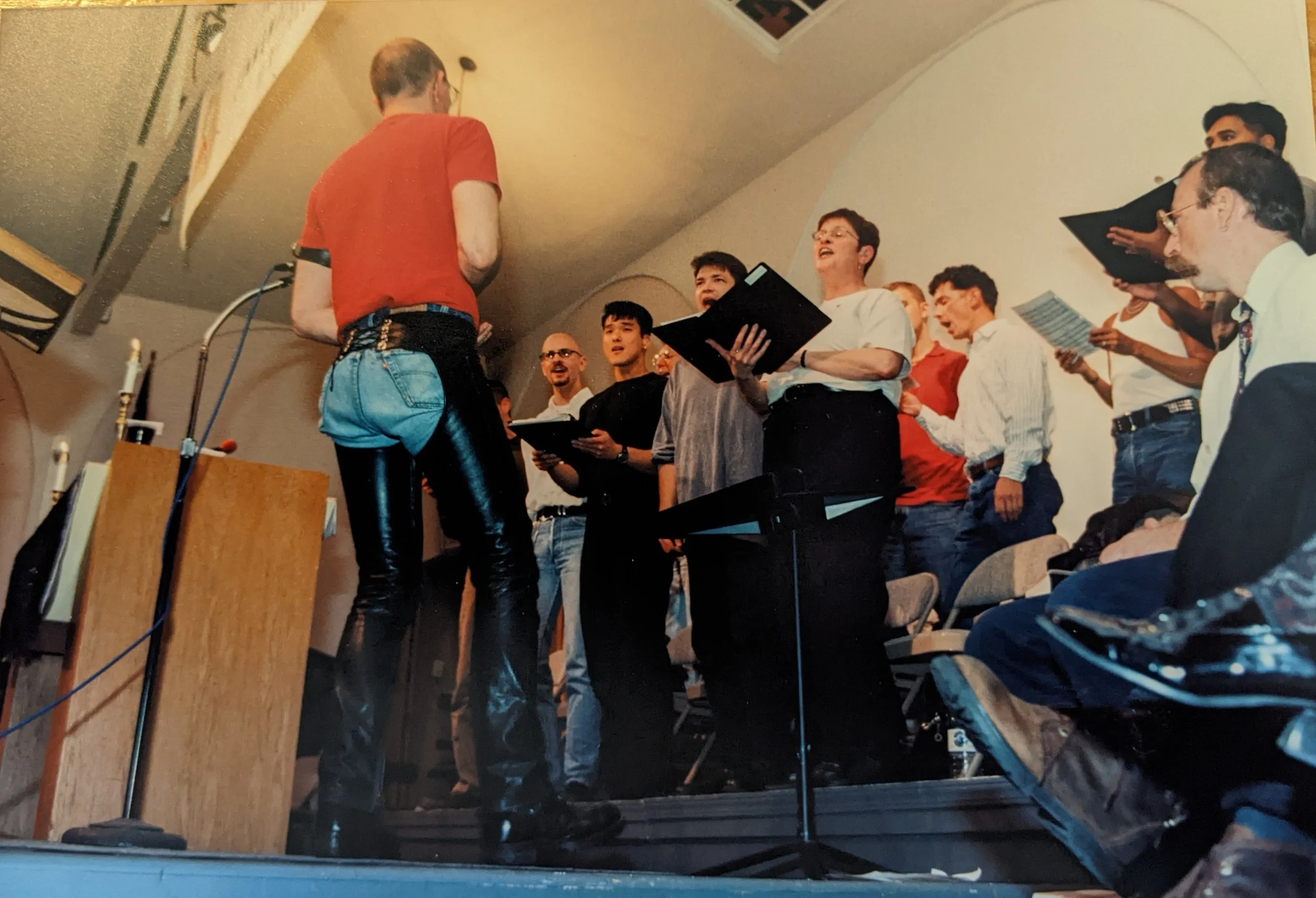
MCC San Francisco lit the San Francisco landmark, Mt. Davidson Cross in rainbow colors on the evening they sang there in 1997. Courtesy of Metropolitan Community Church of San Francisco Collection. San Francisco Public Library.
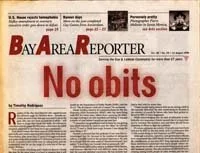
Headline from the Bay Area Reporter with the amazing news that there were no obituaries in the paper that day. August 13, 1998.
In 1996 everything changed. With the introduction of antiretroviral medications called the “AIDS cocktail,” people started getting better – some dramatically – and surviving AIDS became a real possibility. In the wake of these changes, MCC found itself taking stock of what they lost to AIDS and using what they learned to address larger social issues—from medical marijuana to homelessness. Sometimes these political stances felt heroic and a way to use that collective energy, and other times it made the church very unpopular with the changing Castro neighborhood.
NOTES:
Sarah Schulman’s The Gentrification of the Mind: Witness to a Lost Imagination (University of California Press, 2013) takes on the question of AIDS and gentrification.
For an early analysis of the Castro and gentrification see Manuel Castells, The City and the Grassroots: A Cross-Cultural Theory of Social Movements (University of California Press, 1983). For a more recent account that includes an account of the fight over the queer youth shelter in the Castro see Jennifer Reck, Be Queer….But Not Here! Queer and Transgender Youth, the Castro ‘Mecca’ and Spatial Gay Politics (Doctoral Dissertation, Sociology Department, University of California, Santa Cruz, 2005).
Ed Wolf is one of the main characters in We Were Here, a 2011 documentary by David Weisman about AIDS in San Francisco.
The history of the fights to legalize medical (and recreational) marijuana in California is told in Martin A. Lee, Smoke Signals: A Social History of Marijuana – Medical, Recreational, and Scientific (Scribner, 2012) and Alia Volz, Home Baked: My Mom, Marijuana and the Stoning of San Francisco (Mariner, 2020).
“Compassion of the Castro” article from the San Francisco Chronicle, December 2, 2000.
Lynne Gerber was on the board of the MCC Foundation from 2004-2005.
Music:
“Freedom is Coming” is by Anders Nyberg. The soloist is Bob Crocker.
“All Things New” is by Rory Cooney. The soloist is Jean Taylor.
“Blessed Assurance” is by Franny Crosby.
“Gloria (Angels We Have Heard on High” is a traditional Christmas hymn.
“The Potter’s House” is by V. Michael McKay. The soloist is Tessie Mandeville.
THANKS
Special thanks to Tommi Avicolli-Mecca, Tom Ammiano, Matt Sharp, Dr. Jen Reck, Stuart Gaffney, John Lewis, and Dana Van Gorder for talking with us about this episode and connecting us to other folks to talk with.
TRANSCRIPT:
Episode 09 – AIDS energy
NOTE: This audio documentary podcast was produced and designed to be heard. If you are able, do listen to the audio, which includes emotions and sounds not on the page. Transcripts may contain errors. Check the corresponding audio before quoting in print.
Lynne Gerber: When we left off last time, Rev. Jim Mitulski just returned to the pulpit at MCC San Francisco for the first time after his AIDS diagnosis. That was September of 1995. Two months later, the tapes go silent. There are no recordings for two years. They pick up again in November of 1997 and this is the first thing on the first tape after that gap.
Singing: Sing a new song, rejoice, the dawn is breaking, the earth is waking, its dreams come true, and do you hear the voice? Darkness surprising, singing it's rising. [00:01:00] See, I am making all things new.
Lynne Gerber: A whole lot had changed in those two short years. The church was growing. Jim and Penny were leading the church together. Penny Nixon, you might remember, had just started preaching at MCC when Jim got sick. She was about to become co-pastor.
Jim Mitulski: Uh, next Sunday is Reformation Day, and we'll be doing a, a sermon, Penny and I's sermon together, reflecting on the strengths and weaknesses of our Catholic and Protestant backgrounds. Penny will talk about, uh, her Protestant background. I'll talk about my Catholic background and, the innate superiority of it. She'll talk about the poverty of her Protestant upbringing. Just a little joke.
Lynne Gerber: They were experimenting with new kinds of worship services and recruiting new choir members. New relationships were happening. Between the church and other community organizations. And between the church and political leaders in the city.
Jim Mitulski: We have a special guest this morning. And we're always happy to have with us our elected officials. And this morning our guest is a member of the Board of Supervisors.
Lynne Gerber: Sunday worship at MCC had become the place to go for politicians seeking support in the gay and lesbian community. And those relationships were becoming a powerful way for the church to enact its coalition politics on the local level.
Lynne Gerber: But most of what you hear in the tapes isn't as concrete, as tangible as a new program or a new leadership team. It's this sense of energy that isn't as apparent in earlier tapes. And a renewed sense of possibility.
Singing: Whom shall we live for? Whose mighty hand made the moon, the sun and stars on high? Who made a [00:03:00] way for us through water and the sand. Brought us out of slavery and fed us from the sky. Sing a new song, rejoice. The dawn is breaking. The earth is waking. Its dreams come true. And do you hear the voice? Darkness surprising. Sing in it's rising. See, I am making all things new.
Lynne Gerber: Between 1995 and 1997 a sea-change had begun. One that would change everything for the course of the AIDS epidemic, for the Castro and for MCC San Francisco. At the end of 1995 the FDA approved the first protease inhibitor which, in combination with other anti-retrovirals, gave people a real chance to live with AIDS. They called it the AIDS cocktail and by 1997 it was credited with cutting the death rate from AIDS nationally by 47%. Doctors and researchers and activists used biblical language to describe the profound change they were witnessing. They called it the Lazarus effect after the man in the Bible who Jesus raised from the dead. And MCC San Francisco was feeling it.
Jim Mitulski: We talked about, what are we doing with our AIDS energy? That's what it was. Now that protease has changed the nature.
Lynne Gerber: But AIDS energy -- or the newfound possibilities that came with a change in the epidemic - wasn't just one thing. It was a complex set of feelings and motivations and impulses. There was rejoicing for sure. Relief. Amazement. Gratitude. And when the dying slowed, the grief started catching up. And when people started to realize that they may -- just may -- have survived, they started to wonder why. Even though there's no good answer to that question. People wanted to make sense of the suffering and the survival -- maybe even redeem them both. And after dealing with AIDS for the last 15 years, MCC San Francisco wanted to take what they learned from it and address other issues. Issues that were as big and as complex as AIDS. But that, in the Castro in the late 1990s, were much more divisive.
This is When We All Get to Heaven. Episode 9 - AIDS Energy. I’m Lynne Gerber.
Lynne Gerber: The changes happening with AIDS were felt viscerally in the Castro. Intimately. Right there on the streets. This is Justin Tanis, MCC’s associate pastor at the time.
Justin Tanis: I was walking home and, um, was going by where a Coming Home hospice was. And a guy, who I don't know, came around the corner and, and like, did like this and said, they're having to discharge somebody. They'd have to discharge my friend, but they're trying to figure out how to do it because they don't have discharge procedure.
Lynne Gerber: They didn't have a discharge procedure. The hospice had never considered the possibility of someone becoming well enough to leave. And even when that possibility emerged, it was hard for folks to believe it. Hope didn't come easily. Because it felt so close and so far all at the same time. Ed Wolf was a leader in the San Francisco AIDS world and worked at MCC just before the cocktail came out.
Ed Wolf: There's a certain poignancy to that time that people can't appreciate. To think that they're coming over the hill to save you, but they just couldn't get there in time. Terrible. And then, of course, when they did come, all of us, providers, people living with HIV, people living with AIDS, Who had already had their hopes raised and dashed. People were very reluctant to open up to the possibility. People didn't want to have their spirits raised just to have them dashed again when we found out that they didn't work.
Lynne Gerber: It took a while for folks to believe that this was going to work. Like Penny, a lot of people had to see it.
Penny Nixon: It wasn't like one day we woke up and Protease was there and everything was better. You know, it was a number of false starts. And then, then we actually saw people getting better and then we're like, Oh my God, nobody's died for three weeks.
Lynne Gerber: It did work, for a lot of people. Not everyone had access to it. Not everyone got it in time. Not everyone was responsive to it. But, for the first time, when it worked, it worked.
Justin Tanis: The fact that people stopped dying suddenly. Was definitely noticeable. Yeah. Um, and profound.
Lynne Gerber: For some folks the abrupt shift in prognosis was dizzying and disorienting. Going from dying to living was a really big change.
Jim Mitulski: So there was a whole group of people who, you know, graduated from hospice and then were like, What the fuck? I thought I was dead.
Ed Wolf: People were like, oh, oh, okay, I'm not gonna die. I'm going to go on living. Now what?
Lynne Gerber: Some people made choices in the pre-protease reality that looked really different in the new, post-protease reality. Steve Marlowe saw some of the fallout from that in his work with the church.
Steve Marlowe: There's, the insurance industry changing, so that you could, sell your insurance policy out. And so, there are people that got like, 500,000 dollars, and then blew it, and then lived. They didn't have anything now. They blew it ,and lived. I'm like, what do you do with that?
Lynne Gerber: The church had to figure out how to recognize and tend to the unique pains these amazing possibilities could also generate.
Jim Mitulski: But, you know, you couldn't [00:09:00] love people to life who couldn't remember how to live anymore, you know. If that makes sense.
Lynne Gerber: People were showing up at 150 Eureka Street. A lot of people. People they had never seen before.
Jim Mitulski: I believe that the church has grown or is growing again. I've seen it do this in the past, as many of you have who've been here over the years.
Steve Marlowe: There was one, there was a Christmas week. We had the three services, over three services, we had 600 people. That's the most we've done in a cycle. There was also one week where we had 500, You know, this was a magic time. It was a magic time.
Lynne Gerber: The church had to re-learn what it meant to have new people -- new people that they might not lose quite so quickly.
Jim Mitulski: [There’s something happening again, and when our church changes size, every time it becomes something that it’s never been before, numerically and spiritually, I think it’s important for us to remember our roles, our responsibilities, and the blessings that we have.] I think it's critical at this time in the history of our church as we become yet again bigger than we've ever been and more complex as a community, that we remember that we are hosts [00:10:00] who still have an obligation, a spiritual, uh, as a spiritual obligation to welcome those who are not yet among us.
Lynne Gerber: Some of those people were younger people. People who came of age and started coming out while AIDS was ravaging the queer community. AIDS was a reality for them. But it was different.
Kent Brintnall: The way that AIDS showed up in the congregation for the time that I was there was really as a storied presence.
Lynne Gerber: That's Kent Brintnall. He started coming to MCC in 1995, right when Jim was diagnosed. He was a young professional and new to the city. He had been to MCCs in other places and quickly felt that something unique was happening in San Francisco. By 1997 he was a fixture there.
Kent Brintnall: I don't know that I actually ever saw someone with an I. V. Tower. Although I think I did. I think I saw, like, one person once, right? Um, but I can remember [00:11:00] stories about, oh, people used to come with I. V. Towers. People used to come with timers going off to take their meds. I can remember stories of, oh, we used to have Saturdays where we had funerals every hour on the hour, right? Like, I can remember those stories of this is the experience of this congregation, even if the people sitting in this room don't have a lived experience of these stories that are being circulated, right? Like, those became my stories.
Lynne Gerber: Part of what was exciting about that history was that it could be used in service of creating a queer Christianity, one that was grounded in the experience of AIDS but able to look beyond it. That queer Christianity was built on a commitment to radical inclusion -- to learning from the experience of religious exclusion and making space where lots of different kinds of people could find a spiritual home. [00:12:00] People with radically different backgrounds and radically different beliefs became changed by making church together.
Lynne Gerber: People like Lisa Heezen and Tessie Mandeville who are life-partners and met at MCC San Francisco in the late 90s. Lisa grew up Unitarian Universalist, a very liberal-leaning denomination. She wasn't a big God or Bible person and started going to MCC San Francisco mostly to sing there. Tessie was raised a conservative Southern Baptist and took the word of God very seriously. Integrating spirituality and sexuality was really important to her. Lisa was an alto in the choir. Tessie was a soprano.
Lisa Heezen: it was a real moment of cross pollination or being able to bridge differences. And I do think that mine and Tessie's relationship is an example of that. I think we would have met at any other time, you know, before then, and we wouldn't have been able to hear each other. she would have thought I was nuts, I would have thought she was nuts. We would have been like, [00:13:00] okay.
Lynne Gerber: But MCC had stretched them each to be more open to a wider range of beliefs and backgrounds. And to each other. The range of folks that were in the church, actively participating, bringing their different practices and their faith there made it a very creative time at MCC, socially and spiritually.
Kent Brintnall: Part of what made it so exciting, what created so many possibilities, is that you couldn't say where the congregation was theologically. Southern Pentecostal rural boys who believed wholeheartedly in the virgin birth and the divinity of Jesus and the presence of demons could come to that church and feel seen and heard and reflected. And Buddhists who didn't believe in God and didn't really know what this Bible [00:14:00] thing was about, could come and feel seen and heard and like there was something there for them that. That both of those people and all the kinds of people in between, that I think is really the marvel. And that all of the moments felt authentic. It's like, no, we all, we all mean everything we're bringing
Lynne Gerber: MCC San Francisco was doing what a lot of liberal Protestant churches dream about -- creating a community that held this wide range of beliefs and experiences while still feeling authentic. And in the late 90s they wanted to bring that authenticity to new issues. AIDS had taken up a tremendous amount of the church's energy and purpose. They knew how to mobilize to care for a community. But the need had changed. They wanted to do new things, but they weren't quite sure what those new things should be.
Kent Brintnall: My experience of being at MCC was that like, it had revved up, obviously because it had to, in this like, kind of massive way, Like, like a car that's in neutral with its wheels spinning and burning rubber. And then, the thing it had been preparing for and managing and dealing with just kind of fell out of the picture. But all of that, like all of that energy was still there. and all of that, like unmastered trauma was still there too. So there was just like so much stuff and something was going to have to occupy that territory.
Lynne Gerber: So MCC started getting involved in local issues and campaigns. Sometimes in collaboration with community groups and with city government. One early effort -- a first experiment of sorts -- was making medical marijuana available to people with AIDS. In the church building.
Jim Mitulski: [00:16:00] So marijuana was not legal, but it was dispensed. It wasn't a treatment, but it was a pain mitigator and also it created appetite.
Lynne Gerber: This was the mid-90s when California as a state was divided about medical marijauna. The city of San Francisco was on the brink of making it legal and was already letting dispensaries distribute pot to folks who had documented medical need. But the state had a conservative, family-values Attorney General who, in 1996, staged a raid on San Francisco's cannabis buyers' club. The city and its AIDS organizations wanted to keep distributing pot. But they needed a place to do it. So according to Jim, city officials unofficially reached out to him.
Jim Mitulski: Can we distribute marijuana at the church? I mean, it will be you, meaning it would be me, but I distribute the marijuana. So I would have the police department backing it and the health department backing, but they couldn't say it. And it would be a sort of a standoff between me and the [00:17:00] state attorney general. But they were banking on the fact that the government wouldn't arrest me. So we did it and very publicly distributed marijuana week after week, on Sundays from the church. People just had to bring a doctor's note.
Lynne Gerber: It took some folks a minute to get behind this idea.
Tessie Mandeville: No, I almost left.
Lynne Gerber:. Folks like Tessie.
Tessie Mandeville: I was just like, whoa. I got to, I got to really think about this.
Lynne Gerber: But it wasn't anything new she thought that made her change her mind about it. It [00:18:00] was what she saw.
Tessie Mandeville: I saw people. I saw, at the time it was men that I knew in the church that I saw that it made a difference. Because they, they couldn't eat. They were so nauseous and then they'd lost a lot of weight. And so I saw it making a difference. So I thought, okay, then I have to get okay with this.
Lynne Gerber: Others saw religious meaning in it right away.
Steve Marlowe: So I walked through those, those back slash front doors and they're passing out weed… I mean I just went and dropped my jaw on the floor. Like, here is a holy [00:19:00] moment. It was a holy moment. It was the lighting, it was the staging , it was the shape of it. It was just so the right thing to do. That, in my small, I'm part of this. I'm part of this community that's doing this.
Lynne Gerber: Jim didn't stop at opening up MCC San Francisco to medical marijuana distribution. He got other churches in the city to start doing it too. Bishop Karen Oliveto was the pastor at Bethany United Methodist Church at the time.
Karen Oliveto: Jim called me up and said we're trying to create sanctuary churches that can distribute medicinal marijuana. Would your church care to do it? And I'm like, I don't know, that's a big ask. That's a big ask, but you know what? Tell me what it entails. So I went, they had a setup in MCC where people brought their prescriptions and they went and got whatever the prescription entailed. And so I went home that Friday saying, I will talk to my congregation and get back to you. Well, that morning I woke up and there was an article in the Chronicle saying that [00:20:00] I had already said yes. . And I'm like, oh no.
Lynne Gerber: MCC may have been trying to make their hopes a reality before other folks were actually committed to the project. But Bethany United Methodist Church rose to the occasion and started their own distribution project. So did a few other congregations. The campaign was a small step in a large story about the legalization of medical marijuana in the city and the state. But it was big step in MCC's vision of taking bigger risks. Because AIDS changing gave them more room to take risks. And people were up for engaging in bigger issues.
Steve Marlowe: Like, well, what did this church is doing something pretty cool here. Oh, and you're not too much of a church. You're not going to bang me over the head with a Bible. I could do this. Yeah. It's more about service. I could do this. So that was that magic time. AIDS was morphing into something. And, we were, we were doing, we're doing good deeds.
Lynne Gerber: But good deeds meant different things to different people.
Lynne Gerber: I asked Kent what the big issue was the church engaged with when he was there -- the [00:21:00] one that they directed their AIDS energy toward.
Kent Brintnall: It was the experience of homelessness in the Castro.
Lynne Gerber: Homelessness had become a major issue in San Francisco. The population had grown, housing stock had not, and with the wealth gap getting larger stable housing had grown out of reach. People who were unhoused were becoming increasingly visible on the streets and in neighborhoods like the Castro.
Jim Mitulski: A few weeks ago at the evening service, I talked about how I believe that we're being called to yet another level of social service provision, obviously not something that we can't do with our current infrastructure, but something that we can succeed at, because I'm concerned about a population in our city that is under even more rigorous attack today than was true a year ago. We are going into the winter with less shelter beds than we had for the homeless than we had a year ago at this time, and the homeless population has not shrunk in the past year in this city.
Lynne Gerber: [00:22:00] Jim and other church leaders saw this as place where the church could respond. And should respond.
Jim Mitulski: Perhaps you saw on Tuesday in the Chronicle, the mayor's office announcing that they were going to clean up Civic Center.
Lynne Gerber: It was actually a proposal by a city supervisor.
Jim Mitulski: And by cleaning up, really the entire plan was about moving people who are currently living on the streets in this, in the broadly defined Civic Center area somewhere else, but not defined anywhere else. Just somewhere else. No particular increase in social services, no expansion of shelter beds, just moving people somewhere else. Where do we think people go when they get moved somewhere else? As spiritual people, I believe Jesus calls us to think about and pray about and when it becomes clear what we can do, even if it's a small thing, do something about this. We cannot pretend it isn't happening. We cannot close our eyes and say, Oh, uh, Zion is full. We have our place. We have what we need.
Lynne Gerber: AIDS [00:23:00] had mobilized this church. It taught them how to get food to people, how to sit with discomfort, how to provide support. Homelessness was something they could respond to. Something that was in alignment with their calling as Christians. And with the centrality of communion in that calling.
Jim Mitulski: I do believe that Jesus is calling us to be host, not just in worship, but in every aspect of our church life. We have grown in this church, I think, spiritually and materially in the past year because we have not only three services of Holy Communion on Sunday, but three times during the week when we offer meals to those who are hungry, Open communion and open feeding. They're connected somehow. The power of ritual. I believe that we learned about the need to feed from our participation in the Sacrament of Holy Communion. And our feeding is deepening our awareness of what it means to be welcomed unconditionally at a spiritual banquet [00:24:00] each week.
Lynne Gerber: It meant something for a queer church to become a host and start serving meals to hungry people. After so many years of such great need. the folks at MCC were in a position to be able to give, and to give outside their immediate community. And to give as an openly queer church who had learned something from AIDS and, as a result, had something important to share. It was moving enough to me that years later, in 2004, I joined the board of the Metropolitan Community Foundation , which the church set up to run their social service programs. Back in the mid to late 90s, that work was just beginning.
Jim Mitulski: Do you remember when people who were here, who were attending worship, who had been members of our community started experiencing dementia? And it was very painful to watch and be around. Some of you will remember that week after week we would see people that we knew be like people that we didn't know anymore. Walking around, speaking out loud, acting in ways that made us very, very uncomfortable. Some people said they couldn't stand watching it. But no one ever actually said they shouldn't be here. That was a hard time, and I believe we [00:25:00] are blessed spiritually because we learned to live with that aesthetic. The spiritual blessing outweighed the, uh, the infringement on our music and on our prayer together. That's the kind of challenge that I believe Jesus is calling us to now.
Lynne Gerber: So they started doing new programs for unhoused people. They started cooking meals at the church, and making bag lunches to give to folks standing in line at the weekly needle exchange. They made an arrangement with the city to open a local high school on Saturdays so folks could shower there.
Jim Mitulski: We're doing, a whole host of programs like this, again, through the neighborhood We started providing meals for homeless people. The needle exchange, the showers really pissed people off. Really, hugely pissed people off.
Lynne Gerber: The [00:26:00] Castro had always been a neighborhood shaped by dynamics of race, class, and gentrification. The gay Mecca was largely a white, male gay mecca -- made possible by folks who had the resources to purchase old houses in a city neighborhood vacated by suburban flight, fix them up, and make a new kind of neighborhood.
Jim Mitulski: When the church first moved there, it was a renting neighborhood. That meant that all those buildings around there were flats or apartments. The whole apartment would rent for six, seven, eight hundred bucks. So you could for 200 dollars a month have a big bedroom in a big apartment.
Lynne Gerber: AIDS added to already powerful dynamics of gentrification and the concentration of wealth. A lot of apartments were vacated when folks died, apartments that were released from the restriction of rent control, and able to be repurposed, for people who could afford to buy them. It [00:27:00] changed the whole feel of the neighborhood.
Jim Mitulski: Eventually, by the late 90s, those, all those flats had become condominiums that were very expensive. So the whole demographic base of the neighborhood changed. So that's a shift in how the neighborhood felt. And they were the ones who didn't really like us using the building for social services and things like that. Previous, the earlier wave, didn't care. They were the ones using the building for some of those services.
Lynne Gerber: And it sharpened the dynamics between folks who wanted to deal with homelessness by quote/unquote cleaning it up and folks who wanted to provide space and services and support. They wanted the Castro to be a safe and welcoming place to everyone -- especially to queer young people who were drawn to a gay Mecca without the means of surviving there. And then another opportunity to partner with the city came along. It was an opportunity that tested the neighborhood, the [00:28:00] church, and especially Jim.
Jim Mitulski: Oh, the Queer Youth Shelter was at MCC. That was the most controversial thing of all. Do you know this, about this chapter? Oh my God!. Gays against the homeless. That's what I call it.
Lynne Gerber: The folks who wanted to support queer youth -- MCC, businesses like the neighborhood's queer bookstore, and some politicians -- started to mobilize resources to create a long term shelter somewhere in the Castro. Mark Leno was one of the lead players. Most recently he was a California state senator. But in the late 90s he was a new San Francisco city supervisor.
Mark Leno: So I was new to the board of supervisors in April of 1998 and by autumn, there was discussion at the board about the need for emergency homeless shelter as winter approached. And so [00:29:00] we had public hearings, and I remember scratching my head at the time, why are we dealing with this as an emergency shelter need, as if we didn't know that winter came every year. This was ridiculous. if we need shelter, and in particular, if we need shelter for queer youth in the Castro, this is not a seasonal need. It is year round. So I took up that project, to establish a queer youth homeless shelter in the Castro And the problem, of course, was where.
Lynne Gerber: Mark solved that problem. He connected with a gay gym owner who had been homeless himself when he was young who offered his space in the middle of the neighborhood.
Mark Leno: My office arranged for a community meeting. Inside that property at Market, 17th and Castro [00:30:00] to share with the community, the good fortune of our access to that building and what we intended for it.
Lynne Gerber: But this wasn't good fortune to everyone.
Mark Leno: And what I had not expected was the vehemently negative reaction that we got specifically from a lot of gay male property owners, my age, who lived on 17th Street, and were fearful that this was going to become a magnet.
Lynne Gerber: The meeting was crowded and contentious. And very hot.
Mark Leno: I wore a blue shirt, blue dress shirt that day. And I had taken off my jacket because it had gotten so hot and I soaked through this blue shirt and, unlike a white shirt, it turned two shades darker blue because it was so intense.
Lynne Gerber: [00:31:00] Shelter opponents expressed concerns about drug use on the part of the homeless youth, the impact of visible homelessness on local businesses, and outright fear. And when supporters got the funding for the renovations needed to turn the gym into a shelter, a lot of Castro residents were furious. It was going to take some time for the space to become operational. And these kids needed a place to stay. So Jim stepped into the gap and offered space at MCC as a temporary shelter.
Jim Mitulski: But there was huge opposition in the neighborhood. So much so that people offered us money, large sums of money to relocate the youth shelter to other neighborhoods. Even though it's a city funded program. It wasn't like we thought this up. Okay? We hosted it. Because the homeless people, the young people, it was a queer youth shelter, were living in the park, in Collingwood Park, at night. Mostly because wealthy gay men in the neighborhood were having sex with them and giving them drugs or giving them money to have sex with them. We were trying to make it a humane environment for [00:32:00] them. By providing a shelter, only in the winter, mind you.
Lynne Gerber: Jim started preaching about these kids -- who were spending their nights in Collingwood Park, just two blocks away from the church. And parishioners like Bill Gallimore were moved to get involved.
Bill Gallimore: He would preach and he would just emote. It's like, it's going to rain tonight. Why are we debating about whether or not we're gonna shelter these kids? It's cold and it's gonna rain tonight! What are we doing here? Like, it was impossible not to be caught up in the passion of what he was trying to do and take care of people.
Lynne Gerber: The fight over the shelter was intense. And, like AIDS, it played out intimately on the streets of the Castro.
Mark Leno: There were signs that went up in many of these windows on 17th Street, which had a picture of me. And a big red circle and [00:33:00] slash through it. With the message, anyone but Leno.
Jim Mitulski: I mean, people were putting up posters in the neighborhood with my picture on it and my home address. Homeless? Send them to Reverend Jim's house.
Lynne Gerber: And then there was the question of making it happen. The church, including people like Kent, had to step up and create the project that Jim had committed them to. Out of thin air. With little notice and little planning. The queer youth shelter was announced and the board started organizing volunteers.
Kent Brintnall: It was either the day or the next day. And I got a call from Jean who said, Oh, so Jim made this promise and now we have to make it happen. I was at work and I then went to my boss, or however it worked at the time, and just took a bunch of sick leave.
Lynne Gerber: They made it happen. And turned the church into a shelter.
Mark Leno: I don't remember exactly how many, 10 or 15 we had room for. So we laid out mattresses or cots or something every night, and then had to put it all, store it all away so that MCC could use the space during the day. But every night. I made a point after my day at City Hall and then whatever community events I had to go to in the evening to stop at MCC on my way [00:35:00] home and tuck everyone in for the night. It just became my habit.
Lynne Gerber: It wasn't easy. And not every church member loved it.
Kent Brintnall: They did come and sleep in the church. They slept primarily in a room where the morning choir rehearsed before the service. And they were unwashed and smelled really bad and it was hard to be in that room after them. There were people in the choir who were like I'm going to be physically ill. Like, I can't do this. Um, and so there was like that, you know, that was a cost. just as there were people in the neighborhood who didn't want to have this particular population in the neighborhood, there were people in the congregation who weren't real excited about it either.
Lynne Gerber: And then it got harder. Especially when the Bay Area Reporter, the city’s gay newspaper, started getting interested .
Jim Mitulski: Um, one of them overdosed in our [00:36:00] shelter. Curtis is his name. So we called the ambulance, he, uh, went to Davies, he died about eight days later. It was a huge fuss, because we called the paramedics. And they put a recording of the 9-1-1 call on the front page of the BAR.
Jim Mitulski: In which my secretary said, please don't, uh, use the sirens, because the neighbors will be upset. Well, it's true. I mean, we called them, you know, it's like they wanted, what, did they want them to die in the park? So they used this against us to try and close the shelter. Uh, and then they made it look like we were doing something [00:37:00] wrong because he had an overdose. Well, of course he overdosed. I mean, people did overdose all the time. People died in a fucking park all the time and they didn't care about that. And, of course, who brought his mother from Tennessee? Who had never been on a plane. You know, we did. It was there when, you know, they removed him from life support. We were with him all, you know.
Lynne Gerber: The youth shelter at MCC stayed open for about two months after Curtis’s death. They fulfilled their agreement with the city and the project was always meant to be temporary. But they kept looking for ways to support queer youth in the Castro. Mark was eventually able to open a residential program for them in the gym space at 17th and Market. But that’s another contentious story for another day.
At MCC, the shelter project was fueled by AIDS energy. That AIDS energy was a heady, complex brew. It had clarity and vision -- and a sense of possibility. And it had a kind of freneticism born of compound grief, religious righteousness, and no small amount of survivors guilt.
Kent Brintnall: It was amazing to be part of a group of people, a group of religious people, who, for the most part, agreed that you do things that matter, and you can do things that matter, and that the church's responsibility is to be a political, world-changing space and process.
Lynne Gerber:That’s a lot of responsibility for a small church to shoulder. And it’s hard to keep up that kind of momentum.
Kent Brintnall: It's hard to be in that, a space of that kind of, that kind of chaotic energy. Only a certain kind of person can, can handle. I mean, like I said, yeah, I had the kind of job where I could be like, Oh, I have enough sick days and I can take them whenever I want them. And so I can just go and do this thing. Right. Not everybody can do that. I also was like, you know. What? I was 27 years old. I could do it.
Lynne Gerber: AIDS energy inspired people. And it burned them out.
Kent Brintnall: There were a lot of people who had real demands placed on them. and there were big asks and, you know, we did it and it mattered and we should have done it. And again, as a congregant, I probably should have done more but whatever you were contributing, like there was a real, there was a real cost. A lot of people got real wrung out.
Lynne Gerber: Jim and Penny and Kent and Lisa and Tessie and Bill and lots of folks at MCC San Francisco wanted to use their AIDS energy to change the Castro and to change the world. [00:40:00] AIDS energy was forged in sorrow, pain and loss. Social justice -- the liberation of the oppressed -- was a project worthy of that sorrow and pain, and loss. It could make meaning of it. It could make change from it. And it was a way for queer Christians to help re-orient Christianity away from its most limited moral vision and to its most vast.
Penny Nixon: It's the way Jesus lived his life. It's his whole life. The poor and the oppressed. I mean, growing up, I never, ever, ever heard one sermon on the poor. Never in my life. I never heard about the oppressed. I never heard about justice. I heard about personal responsibility and morality. And what not to do as a woman. That's what I heard and about how sinful everybody else was. But I want to say that in the Old Testament, the theme of the poor and the oppressed and justice, it's the second most prominent theme in the Old Testament. In the New Testament, one out of every 16 verses. Has something to do with economics or the poor, and in the Gospel of Luke one out of every seven verses has to do with that. If we spent more time and so did religious organizations thinking about these issues rather than, who's doing what with you know what, we'd be in a lot better place.
Lynne Gerber: But the shelter project showed that the experience of AIDS didn't always lead to a commitment to social justice. Or to the skills and the resources a church would need to start a homeless shelter. Passion for justice notwithstanding. The project broke some people. It broke Jim.
Jim Mitulski: That's why I quit, actually. It is. I couldn't understand it at the time. My, uh, disillusionment with the gay community at that [00:38:00] point.
Jim Mitulski: AIDS was over, the way it had been anyway. And it had not translated. The compassion of AIDS had not translated to a compassion for the poor. You [00:42:00] know, that the city had changed, the neighborhood had changed, and the people who live there now didn't really care about poor people. And the people who had been there through AIDS had relocated, except for a very few, and they hadn't learned anything from it. It was horrible. So, uh, I didn't leave right away, but that was, I knew I was done. That we went through all that, all those valorous years where people, you know, cared for each other. And then, when it became poor people, they didn't care.
Lynne Gerber: Jim Mituski resigned from MCC San Francisco in December of 2000, five months after Curtis died. In an article about his departure, the San Francisco Chronicle called him “The Compassion of the Castro.”
Music – Singing: [00:43:00] In case you have fallen by the wayside of life, dreams and visions shattered, you are broken inside. You don't have to stay in the shape that you're in. The Potter wants to put you back together again. Oh, the potter wants to put you back together again. Oh, the potter wants to put you back together again. In case your situation Has turned upside down And all that you've accomplished Is now on the ground You don't have to stay In the shape [00:44:00] that you're in The Potter wants you To put you back together again. Oh, the potter wants to put you back together again.
Lynne Gerber: But AIDS wasn't over. Jim wasn't over. The church wasn't over. They were broken and they were healing. Just like they learned to be through all of the pre-treatment years. Some of the questions were new and some of the frustrations were new. For some the time horizon had shifted and for many there was a lot of feelings to catch up with. But enduring paradoxes of faith remained for them to keep living into.
Singing: You who are broken, Stop by the potter's house. [00:45:00] You who need mending, Stop by the potter's house. Give God the fragments of your broken life. My friend, the potter wants to put you back together again. Oh, the potter wants to put you back together again. You who are broken, stop by the potter's house. You who need mending, if your heart needs mending, come [00:46:00] on by the potter's house. Give God the fragments of your broken life, my friend, the Potter wants. To put you back together again. Oh, the potter wants to put you back together again. You are broken, and you're broken today. Stop right on by the potter's house. You who need mending, yeah, If your broken heart needs mending, You can stop by Jesus house. Give God the fragments of your broken [00:47:00] heart. My friend, the potter wants to put you back together again. Oh, the potter wants to put you back together again.
Lynne Gerber: Next time on When We All Get to Heaven
Jim: We are a gay church in 1970. We are an AIDS church in 1990. I don't know what kind of church we'll be in 2010, but if we keep putting ourselves out there, we can still be the gate of heaven in ways that we can't even conceive of.
CREDITS
When We all Get To Heaven is a project of Eureka Street Productions and is distributed by Slate. It was co-created and produced by me, Lynne Gerber, Siri Colom and Ariana Nedelman.
If you love the show, we’d love your help. The best way for new listeners to find us is through word of mouth. Please spread the word and tell folks about us. The next best way is through listener reviews. Please review us on whatever app brought you here. Thanks so much!
Our story editor is Sayre Quevedo. Our sound designer is David Herman. Our first managing producer was Sarah Ventre. Our current managing producer is Krissy Clark. Tim Dillinger-Curenton is our Consulting Producer. Betsy Towner Levine is our fact checker. And our outreach coordinator is Ariana Martinez.
The music comes largely from MCC San Francisco’s archive and is performed by its members, ministers, and friends. Additional music is by Domestic BGM.
We had additional story editing support from Arwen Nicks, Allison Behringer, and Krissy Clark.
A lot of other people helped make this project possible, you can find their names on our website. You can also find pictures and links for each episode there at – heavenpodcast.org.
Our project is supported by the Henry Luce Foundation, the E. Rhodes and Leona B Carpenter Foundation and some amazing individual donors. It was also made possible with support from California Humanities, a non-profit partner of the National Endowment for the Humanities. You can visit them at www.calhum.org.
Eureka Street Productions has 501c3 status through our fiscal sponsor FJC: A Foundation of Philanthropic Funds
And many thanks to MCC San Francisco, its members, and its clergy past and present – for all of their work and for always supporting ours.